
Next.js vs WordPress: Which Should You Choose?
An honest breakdown from 10+ years of shipping websites — when a traditional CMS is the right call, and when your business has actually outgrown it.
An honest breakdown from 10+ years of shipping websites — when a traditional CMS is the right call, and when your business has actually outgrown it.
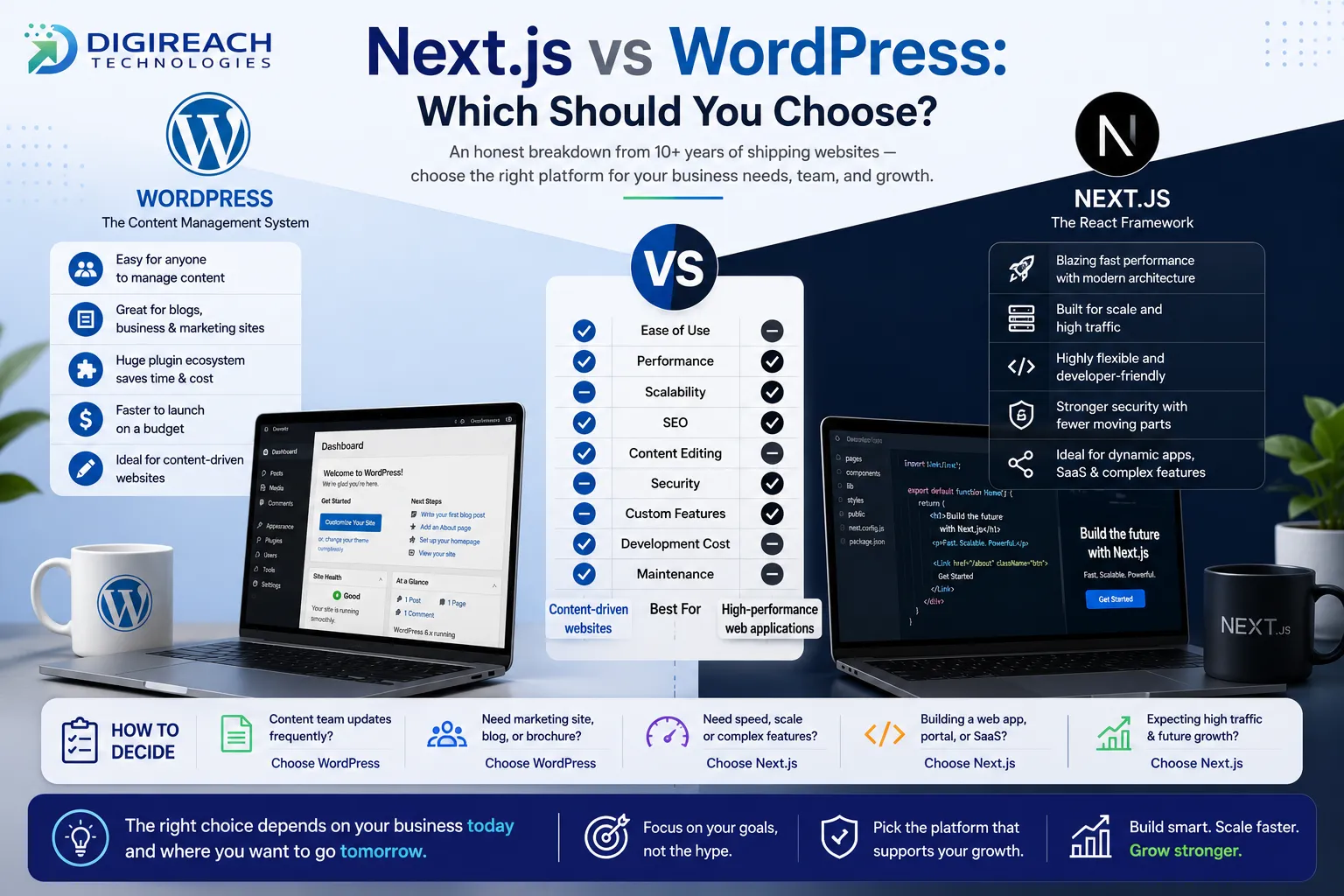
I get asked some version of this question almost every month, usually from a founder or marketing lead who's just come out of a meeting where someone said "we should probably move to Next.js" without being able to fully explain why. So let's settle this properly — not with a religious war between two camps of developers, but with the same lens I use when a client brings this decision to us: what does the business actually need, and what does that need cost to build and maintain?
Both WordPress and Next.js are excellent tools. The mistake isn't picking either one — it's picking one for the wrong reasons.
Let's Start With What Each One Actually Is
WordPressis a content management system. It was built, from day one, to let non-technical people publish and manage content without touching code. Everything about it — themes, plugins, the block editor, the admin dashboard — exists to make content ownership easy for the person who isn't a developer.
Next.jsis a React framework for building web applications. It's not a CMS at all — it's a set of tools for developers to build fast, flexible, highly custom front-ends, often pulling content from somewhere else (a headless CMS, an API, a database). It gives you performance and control, but it assumes you have engineering resources behind it.
That distinction — CMS versus framework — is really the whole answer. Everything else is detail.
When WordPress Is Genuinely the Right Choice
I'll say this plainly, because agencies don't always: for a large share of businesses, WordPress is not a compromise. It's the correct decision.
- You need your marketing or content team to publish independently. If someone without a developer background needs to write a blog post, update a landing page, or swap a banner image on a Tuesday afternoon, WordPress's editing experience is hard to beat.
- Your site is primarily content-driven, not application-driven — think brochure sites, blogs, service pages, most SMB and mid-market marketing sites.
- You need to move fast on a modest budget. With mature themes and the plugin ecosystem, a solid WordPress site can go from brief to live in weeks, not months.
- You rely on a large plugin ecosystem — booking systems, membership portals, SEO tooling, e-commerce via WooCommerce — where "someone has already built this" saves real development time.
- Ongoing content changes will vastly outnumber structural changes to the site itself.
If your business fits this profile, migrating to Next.js won't make you faster or more competitive — it'll just make every content update slower and more expensive, because now it requires a developer.
When Your Business Has Actually Outgrown a Traditional CMS
The conversation changes when the site stops being "a place to publish content" and starts being "a product the business depends on." A few honest signals I look for:
- Performance is now a revenue issue, not a nice-to-have. WordPress can be fast with the right hosting, caching, and plugin discipline — but a heavily plugin-laden WordPress site will almost always lose a head-to-head Core Web Vitals comparison against a well-built Next.js app, especially on mobile. If page speed is directly costing you conversions or rankings, that's a real signal.
- You need highly custom, interactive experiences — dashboards, configurators, real-time data, complex user flows — that go beyond what WordPress's page-and-post model is built for.
- You're scaling traffic aggressively and need the kind of caching, edge rendering, and infrastructure control that Next.js (paired with modern hosting) gives you natively.
- Security and stability at scale matter more than editorial convenience. Fewer moving parts (no plugin sprawl, no constant plugin/theme vulnerability patching) means less attack surface as you grow.
- You're building a genuine web application — a customer portal, a SaaS front-end, a booking engine with complex logic — not a content site at all. This was never really WordPress's job to begin with.
If two or more of these are true for your business right now, that's usually when the Next.js conversation stops being premature and starts being overdue.
The Trade-Off Nobody Likes to Say Out Loud
Here's the part agencies sometimes gloss over: choosing Next.js is choosing to make every content change go through engineering, unless you pair it with a headless CMS (Sanity, Contentful, Strapi, and similar tools) and invest in building a proper editorial workflow on top of it. Done well, that combination — Next.js front-end plus headless CMS — gives you the best of both: developer-grade performance and control, with a content editing experience your marketing team can still use independently.
Done poorly, it means your marketing team files a support ticket every time they want to change a headline.
So the real decision isn't just "Next.js vs WordPress" — it's "do we have, or are we willing to build, the operational setup that makes Next.js's advantages actually usable day to day?" If the answer is no, WordPress with disciplined plugin hygiene and good hosting will outperform a poorly-supported Next.js build every time.
How I'd Actually Advise a Client
When a business brings us this decision, we're not starting from "which technology is better." We're starting from three questions:
- Who updates this site, how often, and how technical are they? This alone eliminates half the debate.
- Is site performance and scale currently a business constraint — losing conversions, losing rankings, hitting infrastructure limits — or is it a hypothetical future concern?
- What's the total cost of ownership, not just the build cost? Next.js often costs more to build and maintain because it requires ongoing developer involvement; WordPress often costs more in technical debt over time if it's not properly maintained (plugin bloat, security patching, performance degradation).
A content-heavy SMB marketing site, a local service business, most blogs and brochure sites: WordPress, done well, wins on speed-to-market and editorial independence.
A high-traffic, performance-critical, highly custom, or genuinely application-like product: Next.js, paired with the right headless CMS and infrastructure, wins on speed, scale, and control.
Neither is the "modern" choice and neither is the "outdated" choice — that framing is more about developer preference than business outcome. The right choice is the one that matches how your business actually operates, publishes, and grows.
Not sure which side of that line your business is on?
A short technical and operational audit of your current site usually makes the answer obvious within a day — before any commitment to a rebuild.
Request a Tech Audit