
How to Scale Meta Ads Profitably Past $10k/Month
Learn why most Meta Ad accounts hit a wall around $10k/month and how to build a better system for scaling profitably.
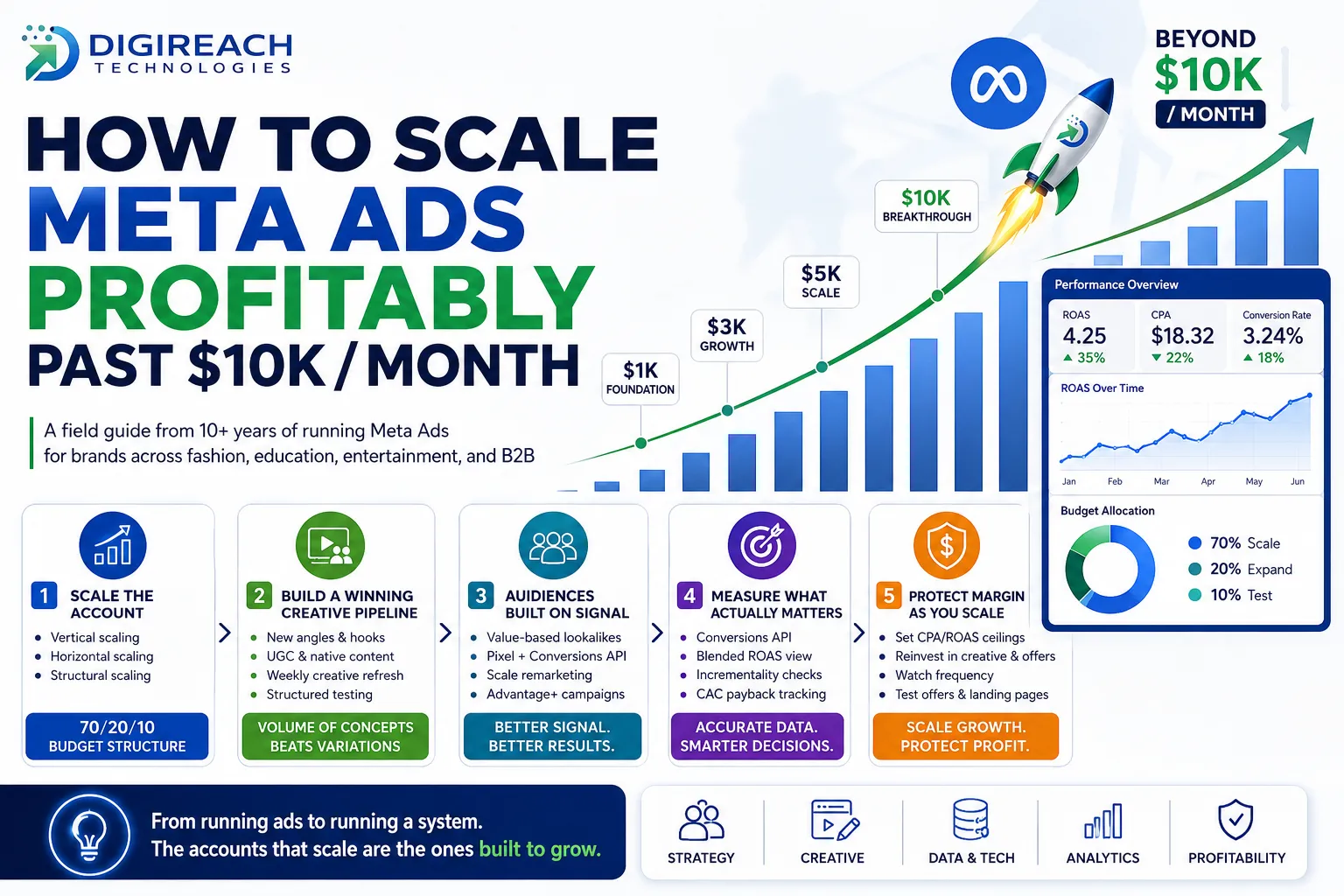
What I've Learned After Managing Meta Ads for Brands Across E-commerce, Education, Entertainment & B2B
Reaching your first $10,000 per month in Meta ad spend is a great milestone.
For most businesses, getting there isn't incredibly difficult if you have a solid product, a decent offer, and creatives that resonate with your audience. Meta's algorithm does a lot of the heavy lifting.
But then something changes.
Your cost per acquisition starts creeping up. Your winning ads suddenly stop performing. Frequency rises. ROAS begins to fluctuate.
The account that felt almost effortless a month ago suddenly becomes frustratingly unpredictable. If you've experienced this, you're not alone.
I've seen this happen with fashion brands, educational institutions, entertainment companies, ticketing platforms, and B2B businesses. Different industries, different audiences—but the same scaling problem.
The good news? There's nothing unusual about it. In fact, once you understand why it happens, getting past that plateau becomes much easier. Let's break it down.
Why Most Meta Ad Accounts Hit a Wall Around $10k/Month
When you're spending a few thousand dollars each month, Meta has an easy job. It can find your highest-intent audience and keep showing your ads to people who are most likely to convert.
As your budget grows, however, Meta has to dig deeper into the audience pool. That's when new challenges begin.
Your Audience Quality Starts Dropping
The easiest conversions have already happened. Now the algorithm has to find people who are less familiar with your brand or less likely to purchase immediately. Naturally, acquisition costs start increasing.
Creative Fatigue Happens Much Faster
More budget means more impressions. More impressions mean the same audience sees your ads repeatedly. People stop noticing them. CTR falls. CPMs rise. Performance slowly declines.
The Algorithm Never Gets Time to Settle
One common mistake is making constant changes. Increase the budget today. Pause an ad tomorrow. Duplicate another campaign the following day. Every significant edit pushes Meta back into the learning phase, preventing the algorithm from fully optimizing.
Tracking Becomes Less Reliable
As budgets increase, small attribution gaps become expensive. Privacy updates like iOS changes, cross-device purchases, and delayed conversions mean Meta isn't always seeing the complete customer journey. That doesn't just affect reporting—it affects optimization too.
Scaling isn't about spending more money on the same campaigns. It's about building a better system.
1. Scale the Entire Account—Not Just One Campaign
One of the biggest mistakes I see is this: A campaign performs well. The advertiser simply doubles the budget. Everything looks fine... until ROAS suddenly drops.
Why? Because every audience has a point where additional spend becomes less efficient. Instead of relying on one campaign, think about scaling in three different ways.
Vertical Scaling
Increase budgets gradually. Around 20–30% every three or four days usually gives Meta enough time to adjust without forcing the campaign back into instability.
Horizontal Scaling
Don't force one campaign to carry your entire budget. Launch additional campaigns targeting nearby audiences, different lookalikes, or slightly different customer segments. This gives Meta more room to find profitable conversions.
Structural Scaling
Many growing accounts end up with ten or fifteen campaigns fighting against each other. That's rarely efficient. In most cases, fewer well-funded Advantage+ campaigns outperform lots of smaller campaigns competing in the same auction.
One structure I've found consistently effective is:
- 70% on proven campaigns
- 20% testing new audiences
- 10% testing bold creative ideas
That balance keeps performance stable while still creating room to discover new winners.
2. Your Biggest Bottleneck Isn't Targeting—It's Creative
Most advertisers spend hours tweaking audiences. Ironically, that's rarely the problem anymore. Meta has become exceptionally good at finding buyers.
What it can't do is create an ad people actually want to watch. At higher budgets, creative becomes your biggest competitive advantage.
New Ideas Beat New Designs
Many advertisers create twenty versions of the same ad. Different colors. Different headlines. Different buttons. That's not creative testing. Instead, focus on completely different ideas. Different stories. Different customer problems. Different emotional triggers.
Five genuinely different concepts will outperform twenty small design changes almost every time.
Authentic Beats Perfect
One pattern has repeated itself across dozens of accounts I've worked on. Highly polished studio videos often lose to simple phone-shot videos. Why? Because they feel real. They blend naturally into social feeds. People don't immediately recognize them as advertisements. That extra second of attention often makes all the difference.
Refresh Creatives Every Week
At smaller budgets, you might rotate creatives every month. At $10k+ per month... Weekly is usually a better rhythm. Creative fatigue happens much faster than most advertisers expect.
Test One Variable at a Time
If you change the hook... the headline... the CTA... and the thumbnail all at once... You'll never know what actually improved performance. Good testing isolates one variable at a time. That's how you build repeatable winners.
3. Feed Meta Better Data
Broad targeting works incredibly well. But only when Meta has enough quality data to learn from. The better the signals you send back, the better the algorithm becomes.
Some of the biggest improvements I've seen come from:
- Building lookalike audiences using high-value customers instead of every purchaser.
- Implementing Conversions API alongside the Pixel.
- Scaling remarketing budgets as cold traffic grows.
- Using Advantage+ Shopping campaigns as the primary scaling engine while keeping manual campaigns for experimentation.
Think of Meta like a GPS. The more accurate the directions you give it, the better the route it chooses.
4. Fix Your Measurement Before Increasing Spend
Many advertisers think scaling stopped working. In reality... Their reporting stopped working. Before increasing budgets further, make sure your measurement is solid.
- Setting up Conversions API correctly.
- Eliminating duplicate conversion events.
- Looking beyond Meta's reported ROAS by measuring total business revenue.
- Comparing customer acquisition cost against customer lifetime value.
- Running periodic incrementality tests to understand what's truly driving sales.
Good reporting creates good decisions. Bad reporting creates expensive guesses.
5. Protect Profit While You Grow
Scaling revenue means very little if profit disappears. As budgets increase, discipline becomes just as important as creativity. A few habits make a huge difference.
Set clear CPA and ROAS limits. If campaigns exceed them for several days, reduce spend instead of hoping performance magically returns.
Keep investing in fresh creatives. Don't spend every additional dollar on media buying. Creative is what keeps acquisition costs under control.
Watch frequency closely. A frequency of 3.5 on a retargeting campaign is completely normal. The same frequency on a cold audience usually means it's time for new creatives.
And don't ignore your landing pages. Sometimes improving your conversion rate by just 10% has a bigger impact than launching five new ads.
The Biggest Mindset Shift
When you're spending a few thousand dollars each month, Meta Ads feel like a collection of individual campaigns.
Past $10,000 per month... You stop managing campaigns. You start managing a system.
Creative production. Audience signals. Tracking. Budget allocation. Testing. Landing pages. Offers.
Everything starts working together. The advertisers who scale successfully aren't necessarily better at running ads. They're better at building systems that keep improving as budgets grow.
Final Thoughts
If your Meta Ads have started becoming inconsistent around the $10k/month mark, don't panic. It's a common stage in almost every growing account.
More often than not, the solution isn't changing your targeting. It's improving your creative pipeline, strengthening your measurement, and building a structure that allows Meta's algorithm to keep learning efficiently.
Once those foundations are in place, increasing budgets becomes much less stressful—and much more profitable.
Thinking about scaling beyond $10k/month?
Before increasing your budget, take a close look at your account structure, creative strategy, and tracking setup. In many cases, fixing just one or two hidden bottlenecks is enough to unlock your next stage of growth.
Schedule a Strategy Call